
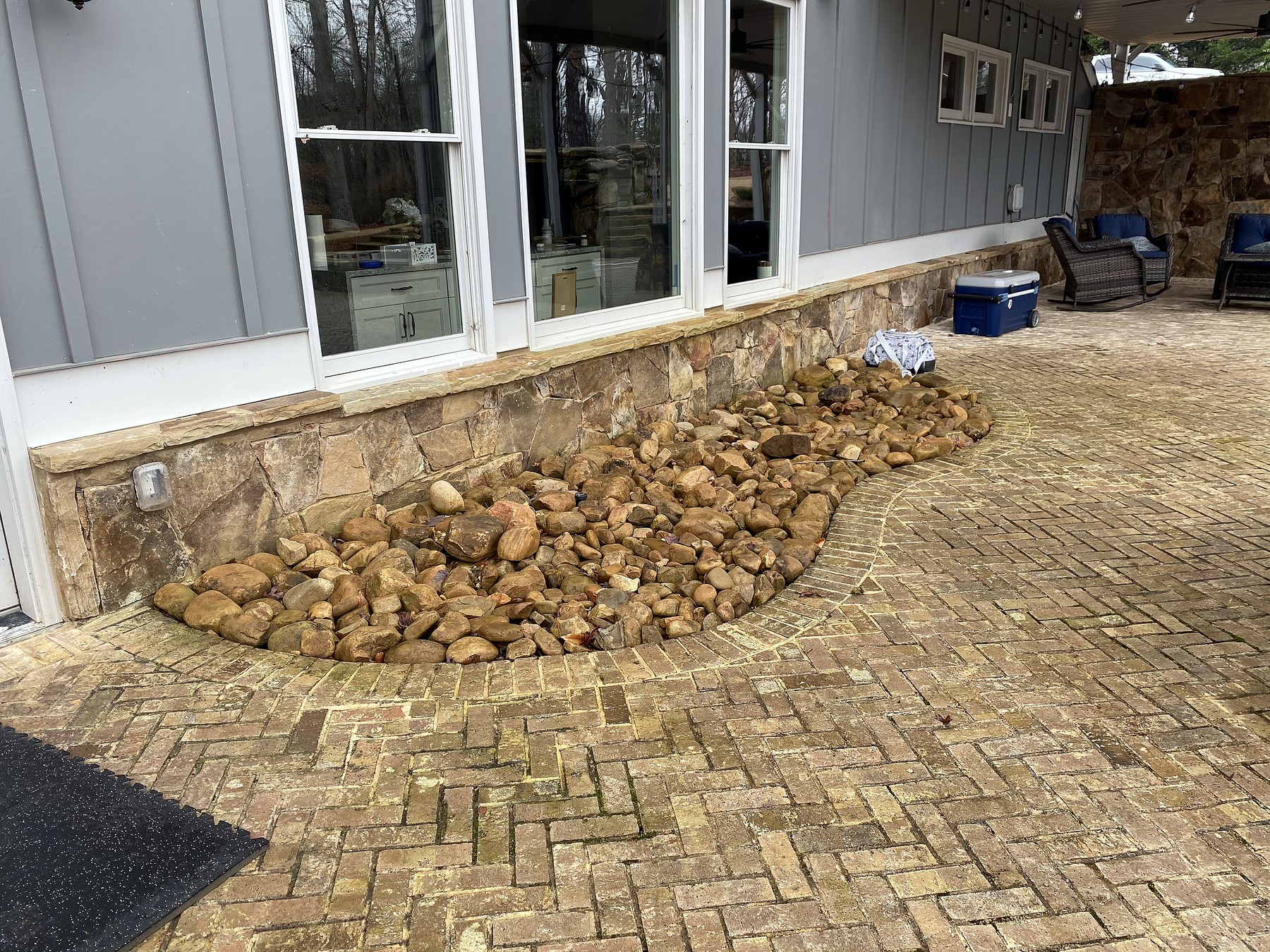
If part of your yard turns into a puddle every time it rains and stays wet for days, that water is doing more than killing your grass. Pooling water against a home works its way toward the foundation, and in North Atlanta’s clay soil it has nowhere fast to go.
Why water pools here
Two things stack up against North Atlanta yards: grade and soil. Many lots slope toward the house instead of away from it, and Georgia red clay drains slowly, so water sits on the surface instead of soaking in. Add a summer downpour and you get standing water exactly where you don’t want it — along the foundation, at the base of a slope, or in a low spot in the lawn.
Why it’s a foundation problem, not just a lawn problem
Water that sits against a foundation saturates the soil, and saturated soil expands and shifts. Over seasons of wet-dry cycling, that movement shows up as cracks, settling, and a wet crawlspace or basement. Fixing drainage early is far cheaper than fixing what standing water does to a structure.
How we move the water
- French drains — a gravel-and-pipe channel that collects subsurface water and carries it to daylight or a drain
- Catch basins — a grated box that swallows surface water at the low point and pipes it away
- River-rock beds & surface drains — for runoff paths and downspout discharge that keep washing out mulch or soil
Most yard drainage runs about $65 per linear foot, and every project starts with a free on-site assessment where we walk the grade and find where the water actually goes. See more on our pricing page.
Georgia’s clay is a big part of why this is so common here — we go deeper on that in Why Georgia’s Red Clay Makes Yard Drainage Essential.