
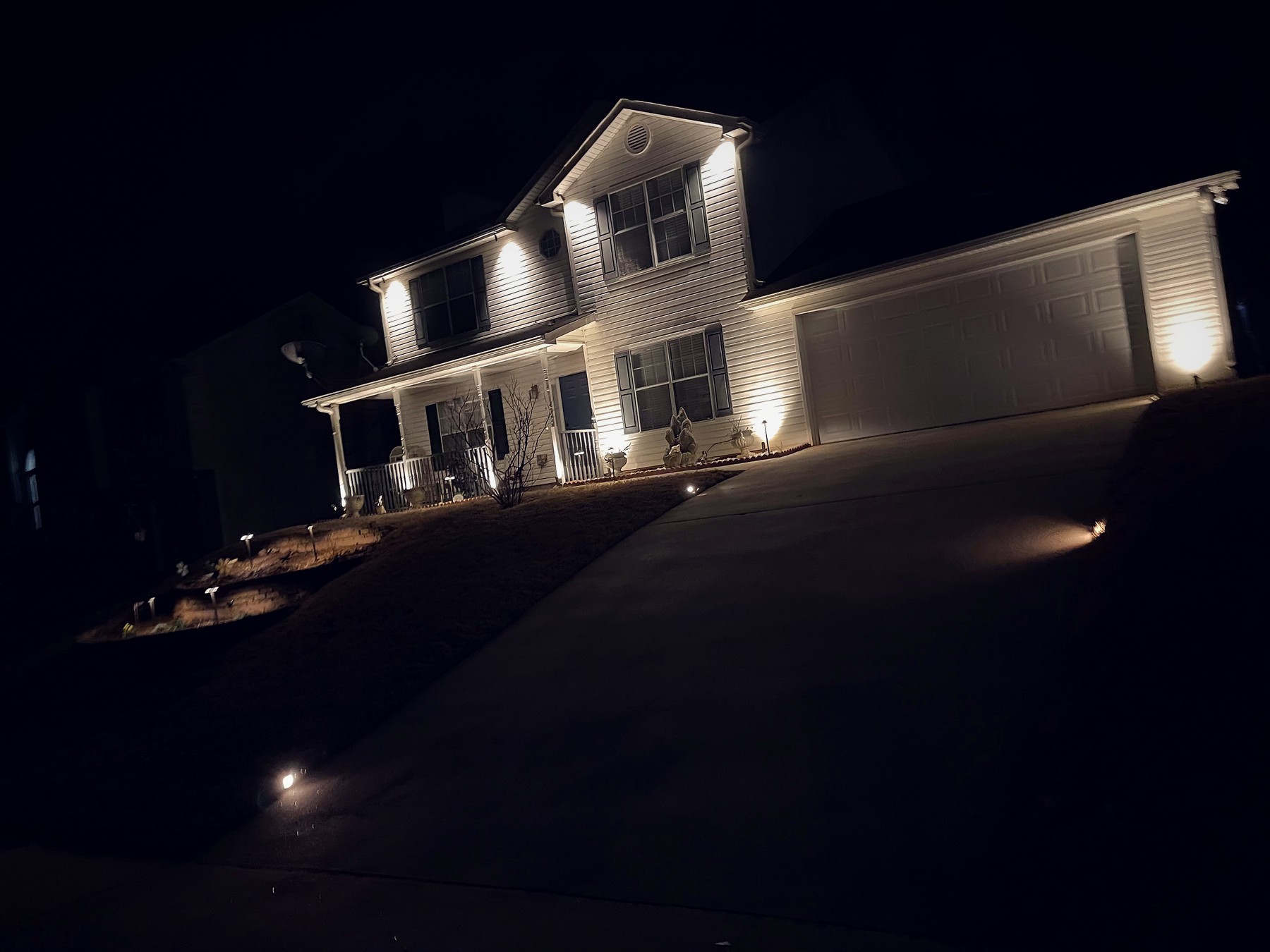
A lot of the prettiest homes in North Atlanta sit up — above the street, at the top of a sloped drive, or set back on a hill. They’re also some of the hardest homes to light well, because everything the viewer sees is at an angle, from below, and from a distance.
Why a slope changes everything
On a flat lot, an uplight at the base of a wall throws light straight up the facade. On a slope, that same fixture aims into the hillside, or washes out over the roofline, or lights the underside of a tree instead of the house. Grade changes the angle of every beam — so the fixture placement that works on level ground is usually wrong on a hill.
Our approach
We treat a sloped lot as a composition seen from the street below:
- Stage the whole hillside, not just the house — the terraced beds, retaining walls, and specimen trees between the street and the home all become part of the picture.
- Aim for how it reads at distance, adjusting beam angles so the facade is evenly lit from the viewpoint people actually see it from.
- Layer the climb so the eye travels up the slope to the home instead of hitting one bright spot.
This is why we design on-site, at dusk
You cannot plan a sloped-lot lighting design on paper or in daylight. We set fixtures on your actual grade, at dusk, and walk down to the street to see what the neighbors and guests will see — then adjust until it’s right. It’s slower than a catalog quote, and it’s the entire reason the result looks designed instead of dropped in.
Landscape lighting starts at $195 per fixture — see the pricing page or our lighting page for the full approach. Lighting a pool or patio on that same sloped backyard? We cover that in Pool & Patio Landscape Lighting.